Showing posts with label 1960s. Show all posts

Friday, August 23, 2013

The Birds (1963)


ALFRED HITCHCOCK


THE BIRDS

USA, 1963

9/10


"Can I bring the lovebirds, Mitch? They haven't harmed anyone."
"Oh all right, bring them."


**Slight spoilers below**


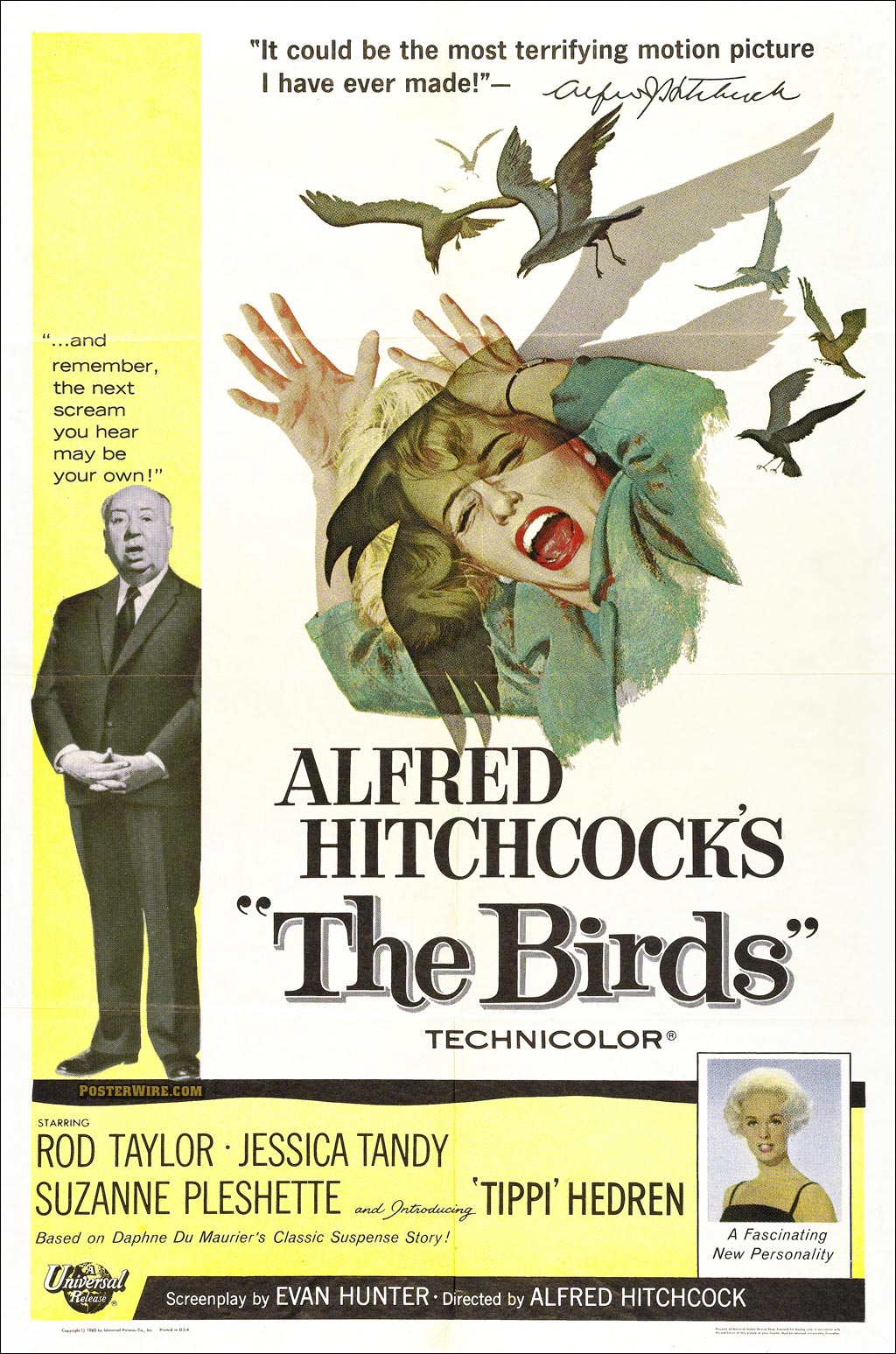
Alfred Hitchcock is my all time favorite movie director, and so when he worked in my favorite genre, the horror genre (which he only did twice in his career), the product is outstanding. This film is fantastic, it's really only 9/10 because it's not as good as some of his other films. The movie follows Melanie Daniels as she pranks a man she met in the pet store to a small town where he spends the weekends with his mother when the house and the rest of the town become under attack by various kinds of birds. That's basically it for the plot. That's why I believe that no director other than Hitchcock could have been able to pull this off as well as he did. 

Something that is curious about the film is its complete lack of a soundtrack. The closest thing we get to music in this film is when Melanie is outside the school, listening to an almost never ending refrain that the school children are singing as a flock of birds grows larger and larger on the playground behind her. This is probably one of the most suspenseful scenes I've ever seen in a horror movie. The complete silence of the attack scenes, save for sounds of screaming people and the cries of the birds gives an incredibly creepy realism to them, and it works brilliantly in this film.

The beginning of the film is strangely light-hearted. It follows Melanie as she attempts to deliver some lovebirds to Mitch without him seeing her deliver them, and even after that, life continues on normally until Melanie attends a birthday party, along with the first (organized) bird attack. I say organized because of mentions of smaller, one-bird attacks (like the bird that hits Melanie on the boat) that aren't on the scale of the later attacks. The rest of the film carries on with bird attacks, followed by peace, only to be followed by more bird attacks, until Melanie and the Brenner family lock themselves in their house. This reminds me of NIGHT OF THE LIVING DEAD (1968) because while they feel safe for the moment, both the audience and the characters know that this peace can't last forever, and that the birds will eventually attack. This plot, due to its feeling of being completely spontaneous, shouldn't work very well, but Hitchcock pulls it off masterfully.

Another thing that Hitchcock pulls off brilliantly is the huge mystery of the film. We never really find out why the birds are attacking, only some different, and probably not accurate, guesses made by various characters throughout the film. This will no doubt annoy some viewers (especially the younger ones), it still works very well in the film. The final shot of the family riding off into the horizon, once again the feeling of current peace yet impending doom, may also annoy viewers, but it works extremely well in the film.

To make some more comparisons to NIGHT OF THE LIVING DEAD, this film is a very character driven one, as there is a lot of down time between the bird attacks where we learn about the various relationships between characters. It is always tricky to do this because if the characters are written with not enough complexity then it's boring, and if they don't respond realistically, it's not scary. However, like NIGHT OF THE LIVING DEAD, all the characters are interesting, believable, multi-dimensional ones. But just because some of the film is focused on the interactions of the characters doesn't meant that there aren't good bird attack scenes, because there are. There is an amazing scene where Melanie stands in a phone booth to escape the birds, and since Hitchcock films this scene from within the booth, we feel just as claustrophobic, exposed, and caged as Melanie does. This is just one of the many superb attacks done by birds throughout the film. The effects in these scenes, while they have aged, are done very well, especially considering the time period they were created in.

All in all, THE BIRDS was a pretty risky film to make. It is extremely character driven, and it is a subject that is pretty difficult to make scary (you have to admit that if you just hear the synopsis, the film sounds a bit silly). Yet Hitchcock manages to pull it off brilliantly in the way that only the Master of Suspense could.

Wednesday, August 21, 2013

Carnival of Souls (1962)

HERK HARVEY

CARNIVAL OF SOULS

USA, 1962

8/10

"It's funny... the world is so different in the daylight. In the dark, your fantasies get so out of hand. But in the daylight everything falls back into place again."


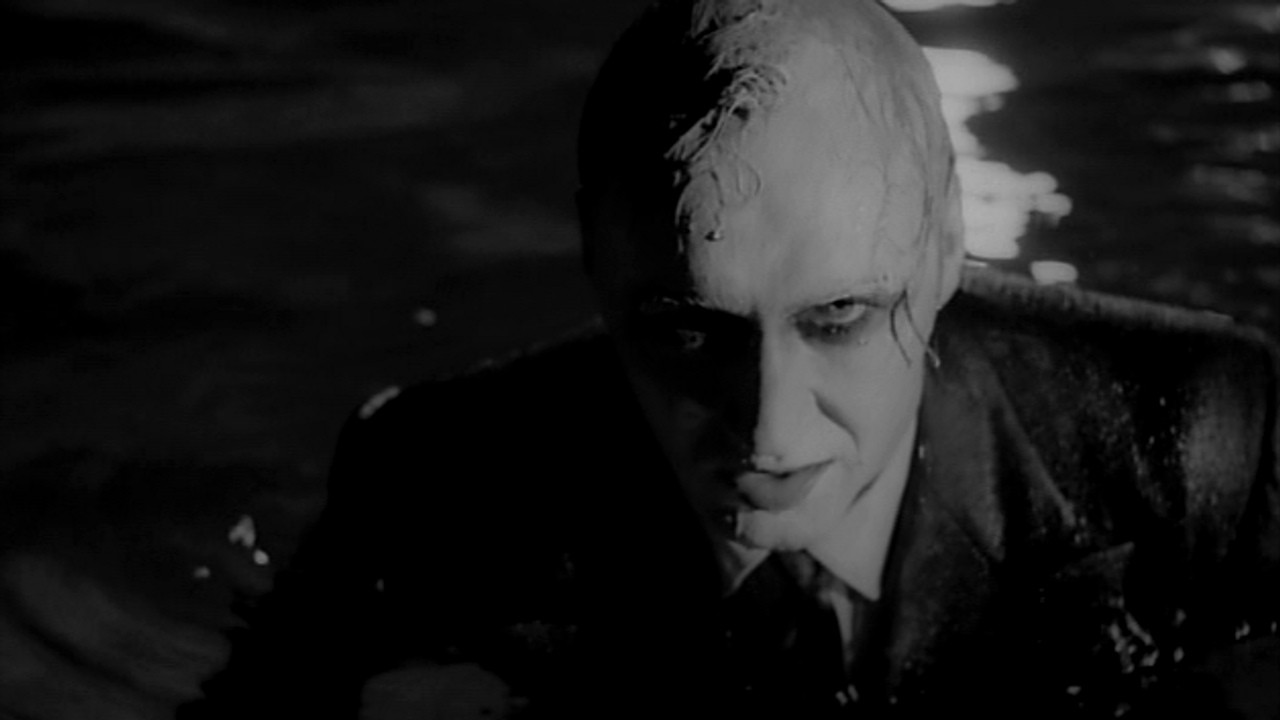
The film opens on a sunny day as two cars are side by side, stopped at a light on an otherwise deserted road. The occupants of the car begin a drag race, neither of them seem officially in the lead until the two cars reach the bridge, where one of the cars loses control and flies off the bridge, landing in the water. Three hours later, the car is still being searched for when one woman, Mary Henry, rises from the water. This is how the semi-forgotten cult classic, CARNIVAL OF SOULS (1962) begins. Many have compared this film's tone to an episode of the Twilight Zone extended to feature film length (well, 84 minutes) and because of this, there are times when the film seems to drag a bit. But this isn't a movie that focuses too much on the plot. More than anything else, it's an atmosphere film. Now, it doesn't have BLACK SUNDAY (1960) (review here) levels of atmosphere, but it still works very well in the film.


In fact, this movie does a pretty good job considering the fact that it had a group of local actors who, on the whole, lacked experience, a budget of only $30,000, was filmed in only three weeks, and a crew of only six people. The acting, while nothing to write home about, is not horrible, but there are moments when it gets a little cheesy. The ghoulish make-up is pretty effective, I found myself creeped out every now and again, especially during the film's climax. The director (who has never made a feature film besides this) actually does a very good job with the film. In the quote above, the protagonist says how the world seems different in the daylight, and the director takes this quote and runs with it. The things that seem innocent in the daylight, such as where Mary stays, or the carnival where she feels drawn, or the church in which she plays the organ, suddenly change in the dark and become threatening. Of course, they physically look the same no matter what the time of day is, but the atmosphere the director builds really does make it seem that these safe and pleasant locations mutate into alarming sights of horror in the dark. Many have commented on how good the soundtrack is, so I will not linger upon it, but it honestly is very good. A lot of it is played on the organ, which makes sense because Mary Henry is an organ player. 

This film was originally ignored by critics and audiences alike, but has gained a cult following throughout the years through late night television screenings and a Criterion release. This film is probably not for everyone. As I mentioned before, the plot is slightly slow moving, yet I was still intrigued and interested for the majority of the film. In fact, there isn't much of a plot at all. It relies almost exclusively on its atmosphere to evoke a feeling of dread and horror. Not to say that there are no jump scares, because there are, but they obviously take the back seat as far as priorities go, and there is no violence, gore, or sex to speak of throughout the film. Instead everything simply feels wrong and uneasy, and throughout the picture we, the audience, get a growing sense that something is wrong, beyond the demon-ghoul thing. The twist ending, while semi-predictable, is still good and allows the viewer to be able to analyze and re-watch the film multiple times. I do recommend that you go into the film without knowing the ending, even if, like me, you guess it about halfway through the movie.

Watching this film, it's pretty easy to see how it may have inspired David Lynch or George Romero, so I definitely recommend that fans of their work check this movie out. All in all, this is a very impressive, yet still modest, piece of low budget horror. Genre fans looking for semi-forgotten treasures (I say "semi-forgotten" because over the years it has gained increasing levels of fame, yet it's still not particularly well known) should definitely check this out. It may not have the best acting, plot, or script, but it does have a great atmosphere and does deliver a couple of rather good scares. It is in the public domain so you can watch it for free online, even though if you're a fan I recommend the Criterion release. Highly recommended.

Monday, July 15, 2013

Black Sunday (1960)

MARIO BAVA

BLACK SUNDAY/THE MASK OF SATAN

ITALY, 1960

8/10

"You will never escape my vengeance, or of Satan's! My revenge will seek you out, and with the blood of your sons, and of their sons, and their sons, I will continue to live forever! They will restore me to life you now rob from me!"


BLACK SUNDAY (1960) opens with the execution of a witch. A mask with nails sticking out of it is placed on the witch's face, and then, using the biggest sledgehammer/mallet/whatever I've ever seen, the mask is struck and the nails are driven into the witch's face. Pretty gruesome stuff for 1960. However, it rains, so the witch cannot be burned, which turns out to be a huge mistake.
  
It stars Barbara Stelle in the role of both the witch Ava and the young heroine, Katia. How she can go from gentle to horrible in just the blink of an eye shows that she is indeed a very talented actress, and proves that she deserved to be among the '60s and '70s horror icons. All of the other actors do a very good job, but no one's performance stood out to me the way Barbara Stelle's did. 

The famous Italian horror director Mario Bava creates a very stunning film that is packed with dark imagery and each shot is full of creepy atmosphere. Even in the beginning scenes, when nothing was really happening yet, I could still feel a huge amount of suspense. There is a gothic feel to the entire feel, which helps it immensely. For Bava's real debut as a director (he did shorts and uncredited directing work before this), BLACK SUNDAY is absolutely amazing. No doubt one of the reasons BLACK SUNDAY is so magnificent (because while the acting and script are very good, they are nothing truly amazing) is because of Bava's skill as both a director and a cinematographer.

The film has many influences from early Universal and Hammer films. I'm not sure if it's true or not, but I read that fact that THE CURSE OF FRANKENSTEIN (1957), a Universal film, and HORROR OF DRACULA (1958) met much success in Italy led to the production of BLACK SUNDAY. Because of this, I feel that this film has the old-fashioned atmosphere of a Universal film, but also features some of the violence of a Hammer film. It is also based on a story by Gogol, which I have not read. The set pieces in this film are absolutely beautiful, especially for a low-budget film. Each shot in the film is beautiful, helped by the Gothic feel and the black and white photography. 

The soundtrack in this film really stood out to me as being quite fantastic. It was creepy, strange, and romantic all at once, and it fit into this movie perfectly. It's very easy for a soundtrack to be intrusive or get in the way of the story (as much as I love SUSPIRIA (1977), the soundtrack is way too attention drawing and distracts from the rest of the move). This film's soundtrack, however, draws just enough attention to itself for the viewer to realize how good it is, but not so much that it stops the viewer from paying attention to the film, and that's really what all soundtracks should do.

All in all, this is a very creepy Italian horror film, and it's pretty short (87 minutes), so you can watch it without it taking too much time. Mario Bava directs the film masterfully, and Barbara Stelle gives an amazing performace. A great watch for fans of Gothic or Italian horror.

Tuesday, June 11, 2013

Rosemary's Baby (1968)

ROMAN POLANSKI

ROSEMARY'S BABY

USA, 1968

10/10

"You're trying to get me to be his mother." "Aren't you his mother?"


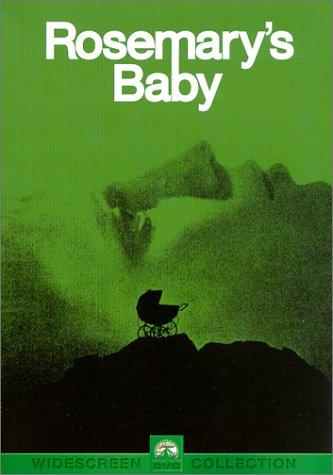
ROSEMARY'S BABY (1968) may be one of the few technically perfect films ever created. Everything, from the screenwriting to the acting to the direction to the pacing, every little detail, of this film is flawless. It is often described as being in a Satanic Trilogy of sorts with THE EXORCIST (1973) and THE OMEN (1976), though ROSEMARY'S BABY is the far superior over the other two films (though, honestly, I find THE EXORCIST scarier, but as far as film making, there's no debate, this film is top-notch).

This film may be the perfect example of subtle suggestion. Upon initial viewing, one may find oneself believing that the film is moving too slow, but in reality, Polanski is merely hinting upon the greater reality at hand. And what a wonderful, twisted, and terrifying reality it is. Sure, because of all the build-up (over two hours worth of it), one may believe that the finale fails to deliver, but I couldn't disagree more. (Very, very small spoilers are ahead) From the second Rosemary walks in to the apartment of the Castevet's, my eyes were glued to the screen, and I sat on the edge of my seat. As Mia Farrow's lullaby begins playing in the background once more, and the screen finally goes to black, I still sat there, transfixed upon the film that I had just watched, or rather, experienced. I stayed there for five minutes before I finally got up, just in awe of the wonderful work of art that had been presented before me.

A huge factor in horror is how the film holds up to rewatch. Out of my top five horror films (in no particular order, THE SHINING (1980), PSYCHO (1960), THE EXORCIST, HALLOWEEN (1978) and ROSEMARY'S BABY), I find myself returning to ROSEMARY'S BABY much more often than any of the others. And the film is so wonderful at foreshadowing and subtle hints that I love finding pieces of information hinting towards the direction in which the film is going.

The acting in the film is wonderful, Mia Farrow being able to completely convince and demonstrate the pains of her pregnancy, those both natural and supernatural. The Castevets are both wonderful, giving off the feeling of being friendly and supportive, though something darker lurking underneath. Ruth Gordon was awarded an Oscar for her role, and she definitely deserves it.

To fans of psychological and supernatural horror, ROSEMARY'S BABY is highly recommended, being not only one of the best horror films of all time, but one of the best films in all of cinematic history.